I See AI Everywhere.


I see AI everywhere.
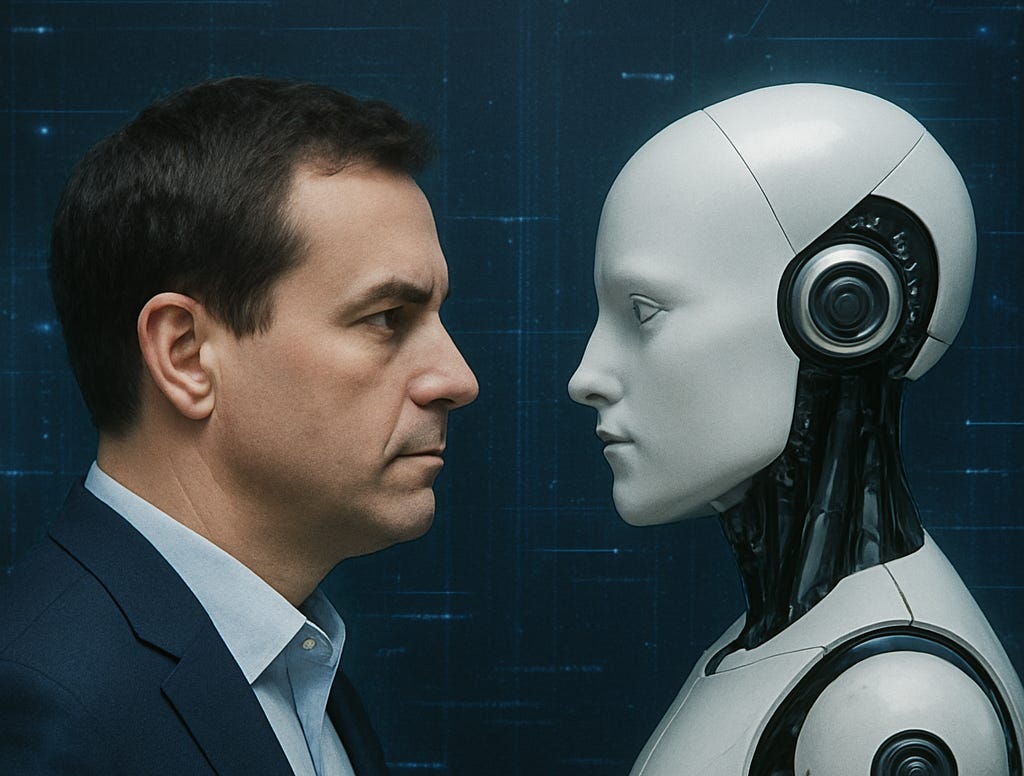
Throughout the many conferences and tech events I’ve attended recently, one theme has echoed louder than ever: artificial intelligence. From keynote speeches to casual coffee chats, from demonstrations of lifelike avatars to deep dives into generative agents and autonomous systems, AI isn't just part of the future; it's the main event now.
The articles flood in daily: “Will AI take your job?” “Should we regulate it like nuclear tech?” “Is artificial general intelligence ethical?” The discourse is polarizing; people either champion AI as the next great leap for humanity or fear it as the death knell for jobs, creativity, or meaning.
I’m neither for AI nor against it. What I believe, what feels almost inevitable, is this: AI can eventually be engineered to do every job humans currently do. With enough domain-specific prompting, architectural fine-tuning, multimodal inputs, and reinforcement learning from real-world feedback, nearly every job, yes, even the “creative” ones, can be systematized.
But here’s the twist: we won’t allow it.
In 2023, OpenAI’s GPT-4 stunned the world with its capacity to pass bar exams, solve advanced coding challenges, write novels, and even offer decent therapy. Two years later, models like Google’s Gemini 2.5, Meta’s Llama 3, and OpenAI’s GPT-4.5 (with multimodal capabilities) are being embedded across industries; customer service, legal review, software engineering, healthcare diagnostics, you name it.
According to a Goldman Sachs report, AI could replace the equivalent of 300 million full-time jobs globally, especially in advanced economies. In the US alone, it is estimated that two-thirds of jobs are exposed to automation. In Singapore, it’s 83%.
Statistically, we’re already seeing results:
GitHub’s Copilot is writing 46% of all code on its platform, as of late 2024.
AI-assisted design tools are reducing product cycle timelines by 30–50%.
McKinsey projects that AI could contribute $4.4 trillion annually to the global economy.
Yet… unemployment isn’t skyrocketing. In fact, many economies are seeing labor shortages, not surpluses. Why?
Here’s my hypothesis: the limits of AI aren’t technological. They’re socio-political.
Allowing AI to fully replace jobs isn’t just a matter of capability; it’s a question of control. A society where AI replaces every job challenges three deep-rooted systems:
Hierarchy
Work gives us ladders. Job titles, promotions, status markers. Remove that, and what's left? A CEO is only powerful if there's a hierarchy below them. If AI can replace the intern, then the manager, then the director… what separates us?Economic Distribution
If AI performs all jobs and productivity goes parabolic, who gets the value? In current systems, capital owns the output. If 90% of value creation flows to those who own the algorithms and compute, the wealth gap doesn’t just widen, it explodes. Governments know this. This is why regulatory frameworks are already creeping in (see EU AI Act, Biden’s initial AI Executive Order).Human Identity
We derive purpose from work, rightly or wrongly. When AI can write better novels than authors, compose more moving music than composers, and perform surgeries more accurately than doctors, it threatens not just income, but meaning.
So, What Happens Now?
We’ll continue this awkward dance with AI, pushing it forward just enough to boost GDP, cut costs, and innovate… but never all the way.
AI will not replace all jobs, not because it can’t, but because we will actively slow it down.
Some jobs will remain protected, regulatory-anchored roles (e.g. politics, law, finance, where AI can but not legally replace), high-context human jobs (e.g. social work, caregiving, and leadership roles rooted in trust, nuance, and emotion that humans want to feel), prestige roles (e.g. artists, designers, or thinkers, where AI might outperform, but society wants the human touch).
And some jobs will be “invented” to fill the vacuum, as we’re seeing a rise in “AI whisperers,” “prompt engineers,” and “alignment researchers”, positions that didn’t exist five years ago.
The Future is Uneven; By Design
The world won’t become a techno-utopia where everyone gets a universal basic income and AI does the heavy lifting. At least, not soon.
Instead, we’ll engineer artificial scarcity, limiting what AI is “allowed” to do through regulation, licenses, ethical frameworks, and social norms. AI may be capable of building a perfectly balanced economy with zero labor, but humans don’t want balance. We want identity, purpose, and uneven playing fields where we can compete.
I see AI everywhere.
But what I see even more clearly…
Is the invisible human hand still gripping the brakes?